Guides
Paris Fashion Week: Define the Chauffeur Service Scope
A practical guide to deciding whether your Paris Fashion Week transport brief is a direct transfer or dedicated chauffeur coverage across several venues.

A Paris Fashion Week chauffeur request becomes clearer when it describes the movement required rather than simply asking for a car. A direct transfer has a defined collection point and destination. Dedicated coverage involves a changing schedule, waiting and continued coordination across shows, fittings, showrooms or events.
The distinction affects the itinerary, vehicle brief, contact process and instructions given to the chauffeur. It should therefore be settled before the transport request is submitted.
Choose between a transfer and as-directed coverage
A point-to-point transfer covers a defined journey between an agreed pickup and destination. For a Fashion Week movement, the request should identify the passenger contact, official entrance, collection point, destination and relevant access instructions.
The Riddr reference page does not explicitly present a standalone point-to-point Fashion Week product. If your requirement is limited to a direct transfer, describe it as such and ask for confirmation that this scope can be arranged rather than assuming that it forms part of the dedicated service.
An hourly or as-directed request has a broader purpose. The chauffeur may need to remain connected to the working itinerary while timings or collection points change. Riddr confirms dedicated chauffeur planning around fixed show times, provisional fittings and realistic travel margins. The chauffeur receives the current itinerary and waits within the confirmed operating period.
That confirmed operating period is the important boundary. It should not be treated as unlimited waiting or open-ended availability. State when coverage should begin, what movements it should include and where the planned service should end. The related guide to hourly chauffeur scope in Paris explains why keeping a car with the itinerary is different from booking an isolated journey.
| Request format | Suitable brief | Detail to confirm |
|---|---|---|
| Point-to-point transfer | A defined pickup followed by a defined destination | Whether the requested transfer is available, plus the exact collection and arrival points |
| Hourly or as-directed coverage | Several connected appointments with waiting between movements | The confirmed operating period, itinerary boundaries and update process |
Private passenger transport operates within a regulated framework in France. The government provides an overview of taxi and VTC regulation and separate information on access to the passenger transport profession. These references explain the professional framework; they do not replace confirmation of the commercial scope requested for a particular Fashion Week itinerary.
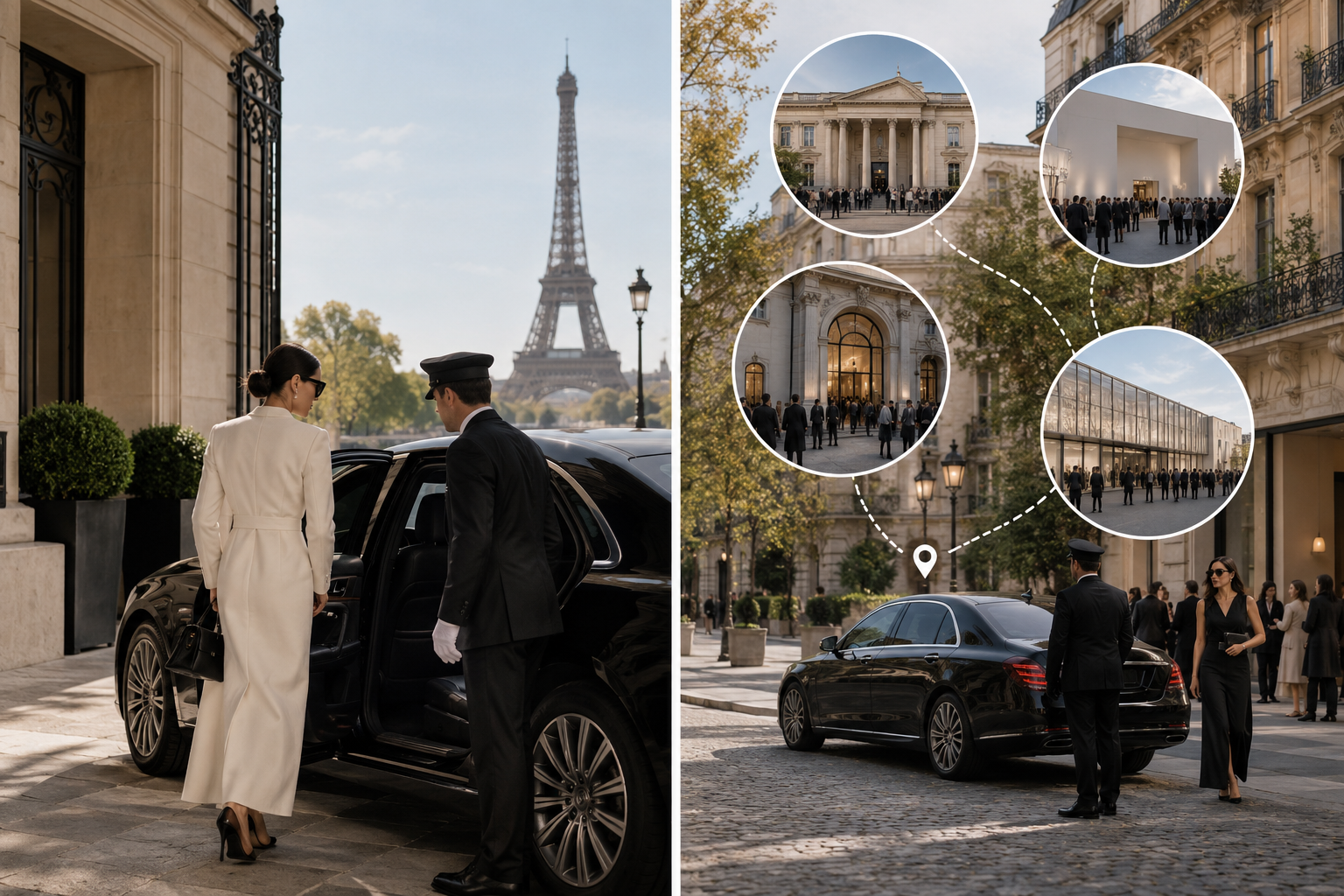
Conceptual illustration of a point-to-point transfer compared with as-directed venue coverage; not a photograph of the service.
Turn the Fashion Week diary into an operating scope
A list of venue names is not yet an operational itinerary. Each movement should distinguish fixed commitments from provisional ones. Show times and confirmed appointments form the stable structure, while fittings, casting calls and evening plans can be marked as subject to an update.
For each venue, provide the official entrance when it becomes available. Accreditation notes, backstage instructions and an on-site contact help prevent the chauffeur from relying on a public address that does not match the production entrance. The reference service specifically supports multi-venue logistics, multi-casting routes, backstage drop-offs and early access drops for setup.
The update channel also belongs in the scope. Riddr describes a designated coordinator controlling itinerary updates so that the passenger, chauffeur and production team work from the same version. Your brief should therefore name the person authorised to change a pickup, replace a venue or adjust the order of movements.
A clean handover separates confirmed information from pending decisions. Include the current pickup sequence, official access notes and passenger contact details, then identify which appointments still require confirmation. This gives the transport team a usable plan without presenting tentative arrangements as final instructions.

Conceptual illustration of an operational itinerary handover; not a photograph of the service.
Confirm the vehicle and handover details
The reference page confirms Mercedes sedans or vans and describes equipment-friendly vehicles. It does not state passenger, luggage or equipment capacities. The request should specify the people travelling together and the items that must be carried, then ask Riddr to confirm the suitable vehicle and loading arrangement.
This matters when the working party includes models, photographers, buyers, stylists or press. Garment bags, cases and photographic equipment should be mentioned explicitly rather than grouped under a generic luggage note. Do not select a sedan or van by assumption; describe the load and allow the vehicle choice to be confirmed against the actual requirement.
The handover should also cover who meets the chauffeur, which contact receives updates and whether equipment remains with the travelling party between stops. Discreet transport between fittings and shows is identified on the reference page, but venue access still depends on the official production instructions supplied for that movement.
The final choice is therefore practical: decide whether you need a defined transfer to confirm or dedicated coverage within an agreed operating period. Once that boundary is clear, the venue sequence, contacts, access notes and vehicle requirements can be sent through the Paris Fashion Week chauffeur service page.