Guides
Corporate Roadshow Paris: A Practical Chauffeur Planning Guide
A field guide to coordinating executive meetings, vehicles, buffers and schedule changes during a Paris corporate roadshow.

A corporate roadshow in Paris needs more than a driver and a list of addresses. It needs one master itinerary, one authorized coordinator, realistic transfer buffers and a clear protocol for changes. The chauffeur service becomes the mobile operating layer connecting executives, assistants, meeting hosts and venues throughout the day.
This guide explains how to plan a corporate roadshow in Paris with clear timings, responsibilities and operating limits.
Key takeaways
- Keep one master itinerary
- Assign one decision maker
- Group meetings by business zone
- Use written change confirmations
Why a corporate roadshow Paris fails operationally
The common failure is not a poor vehicle. It is contradictory information. The executive has one calendar, the assistant has another and the driver receives a screenshot without access instructions. A professional roadshow plan consolidates those sources before service begins and makes every later change visible to the same coordinator.
The practical task is to convert that insight into instructions that can be checked. Before confirming the service, decide who needs each detail, when it must be updated and which change would affect price, timing or vehicle capacity. A useful itinerary does not pretend to predict every minute. It makes priorities, assumptions and operating limits visible.
- Create a versioned itinerary
- Include host mobile numbers
- Record access and pickup instructions
Group meetings by geography
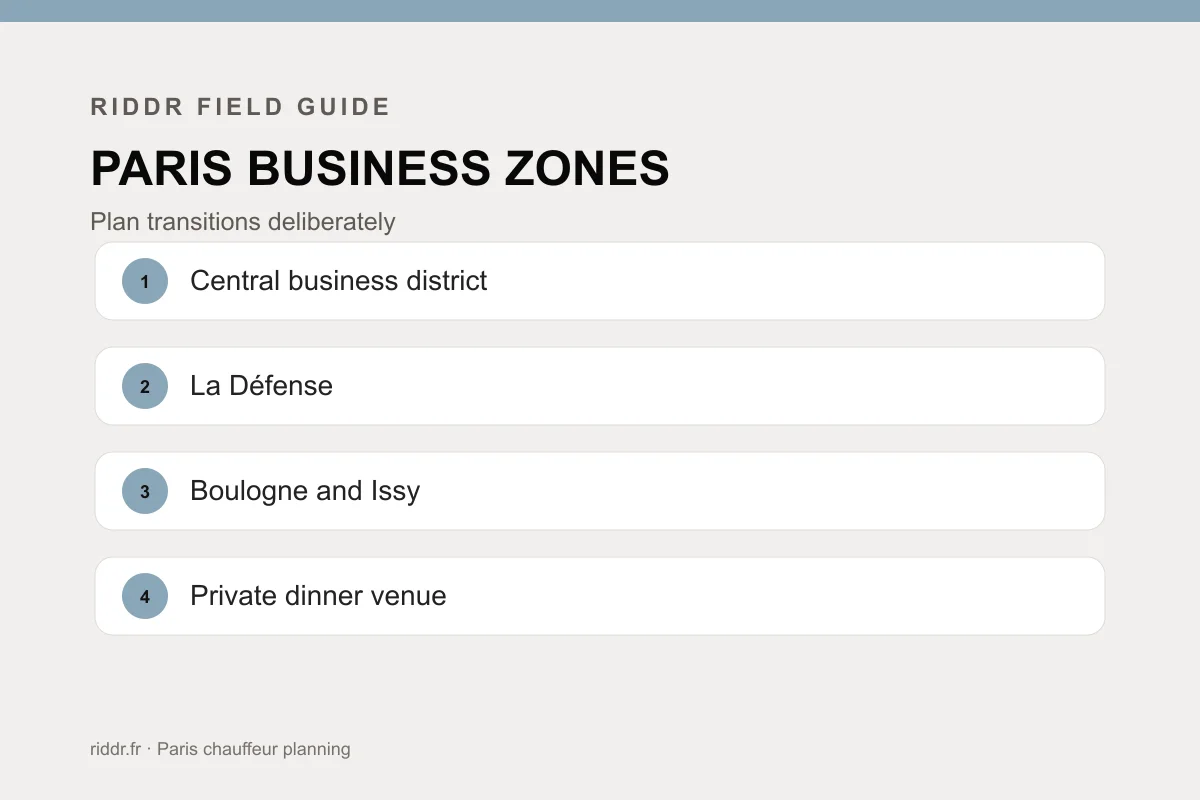
Central Paris, La Défense, Boulogne-Billancourt and Issy-les-Moulineaux may all appear close on a regional map, but transitions between them consume valuable time. Grouping appointments by zone reduces exposure to traffic and leaves more room for the meetings themselves. When geography cannot be changed, the sequence should acknowledge the difficult crossing instead of hiding it.
The practical task is to convert that insight into instructions that can be checked. Before confirming the service, decide who needs each detail, when it must be updated and which change would affect price, timing or vehicle capacity. A useful itinerary does not pretend to predict every minute. It makes priorities, assumptions and operating limits visible.
- Map every venue before confirming times
- Cluster nearby meetings
- Flag the longest transition
Build a master itinerary
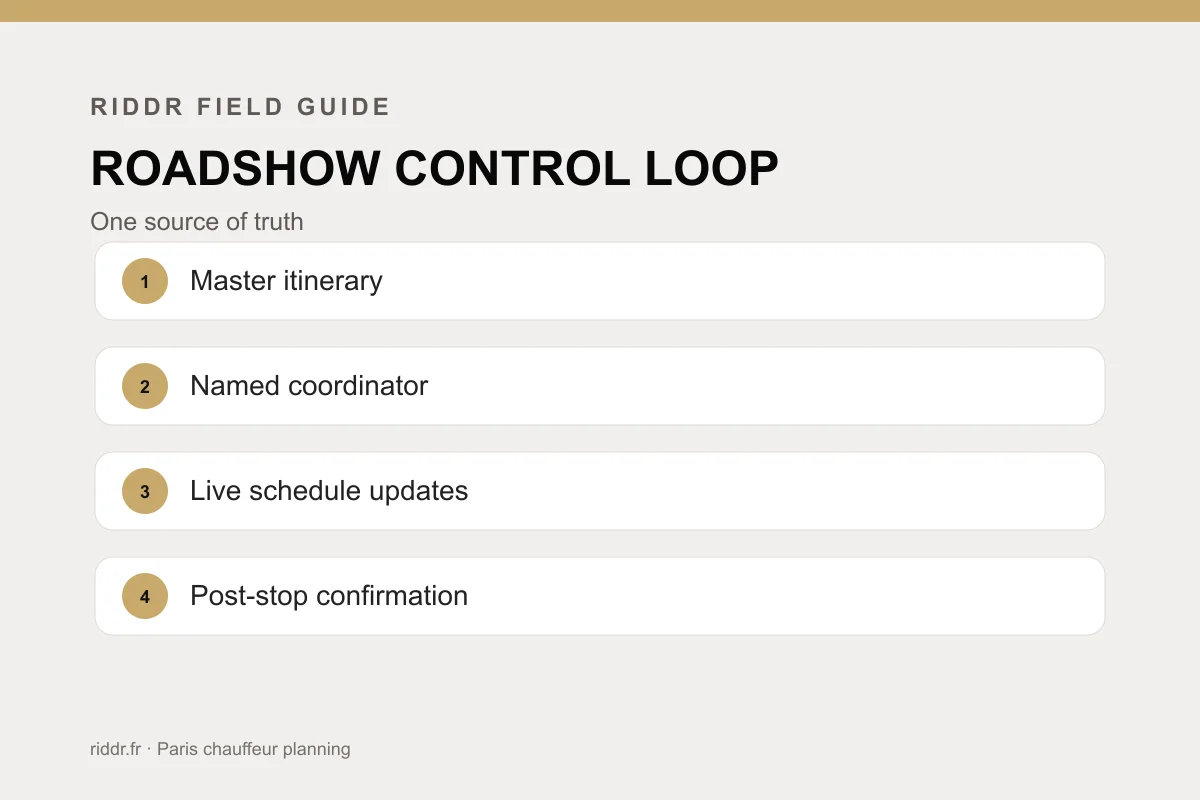
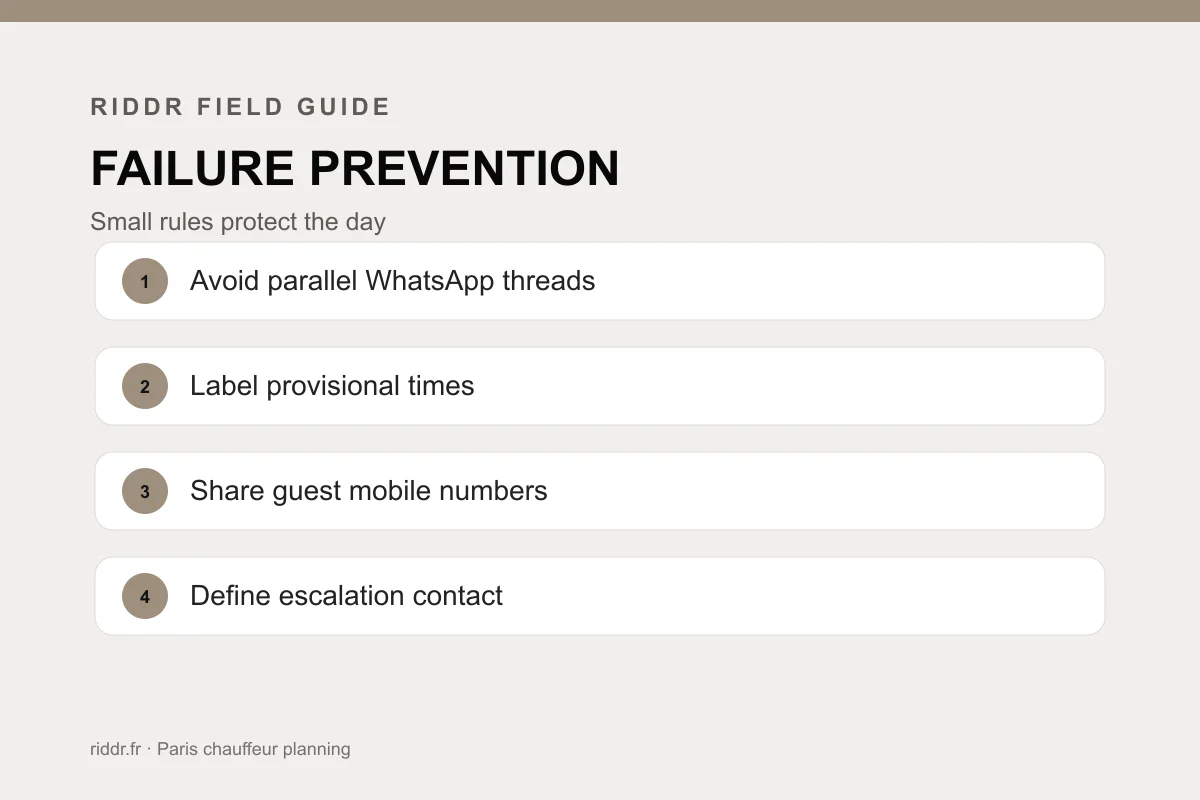
The master document should show passenger names, vehicle assignment, pickup point, target arrival, host contact and status. Provisional meetings must be labelled as such. A roadshow is easier to run when dispatch can see the difference between a confirmed boardroom and an optional coffee meeting. The document should be readable on a phone, not only in a complex spreadsheet.
The practical task is to convert that insight into instructions that can be checked. Before confirming the service, decide who needs each detail, when it must be updated and which change would affect price, timing or vehicle capacity. A useful itinerary does not pretend to predict every minute. It makes priorities, assumptions and operating limits visible.
- Use local Paris time
- Show target arrival separately from meeting time
- Keep sensitive data to the minimum
Choose vehicles by role
A principal sedan may carry the lead executive while a V-Class supports colleagues or advisers. For a larger delegation, vehicle numbering and passenger manifests become essential. Avoid changing vehicle assignments casually during the day: a small switch can separate a guest from documents, security staff or the person expected at the next meeting.
The practical task is to convert that insight into instructions that can be checked. Before confirming the service, decide who needs each detail, when it must be updated and which change would affect price, timing or vehicle capacity. A useful itinerary does not pretend to predict every minute. It makes priorities, assumptions and operating limits visible.
- Name or number each vehicle
- Assign passengers before pickup
- Keep one spare seat where practical
Control live schedule changes
One authorized person should send changes in a consistent format: new time, exact location, affected passengers and whether the next appointment remains valid. Group chats with several people issuing instructions create delay rather than flexibility. The driver should acknowledge the operational update, while commercial changes such as extra hours remain confirmed through dispatch.
The practical task is to convert that insight into instructions that can be checked. Before confirming the service, decide who needs each detail, when it must be updated and which change would affect price, timing or vehicle capacity. A useful itinerary does not pretend to predict every minute. It makes priorities, assumptions and operating limits visible.
- Use one coordinator
- Require acknowledgement
- Separate route updates from commercial approval
Close the loop after every stop
A short confirmation after arrival protects the rest of the day. The coordinator can mark the passenger delivered, verify the next pickup and surface any delay immediately. This is particularly useful when executives split across vehicles. It turns transport from a sequence of assumptions into a managed process without creating unnecessary reporting overhead.
The practical task is to convert that insight into instructions that can be checked. Before confirming the service, decide who needs each detail, when it must be updated and which change would affect price, timing or vehicle capacity. A useful itinerary does not pretend to predict every minute. It makes priorities, assumptions and operating limits visible.
- Confirm arrival
- Recheck the next pickup
- Escalate delays before they compound
A worked schedule example
- 08:15 principal pickup
- 09:00 central Paris meeting
- 11:30 La Défense meeting
- 14:30 Boulogne session
- 18:00 investor dinner arrival
This example is not a universal duration claim. It shows how a useful brief combines commitments, margin and a defined finishing point. Dispatch can quote and plan more accurately when it knows which parts are mandatory and which may move if the day changes.
Mistakes that create avoidable friction
- Multiple people instructing drivers
- No target arrival time
- Vehicle changes without manifest updates
- Scheduling Paris and La Défense back-to-back without margin
These errors look minor on a spreadsheet, yet they usually surface after the vehicle is already in service. Fixing them in advance reduces messages, waiting and disagreement between what the client imagined and what the provider priced. The strongest chauffeur plan is often the one with the fewest unresolved assumptions.
How to request an auditable quote
Send the date, Paris local start time, expected duration, passenger count, preferred vehicle and main stops. Add language, materials, child seats or access requirements. Ask the proposal to state included hours, extension conditions and exceptional expenses. For a schedule-based proposal, review Riddr's corporate chauffeur service in Paris and private chauffeur fleet options. For a different service format, the request a roadshow quote provides the next relevant step.
Frequently asked questions
How many vehicles does a roadshow need?
It depends on passenger groups, confidentiality, luggage or materials and whether meetings occur in parallel.
Can schedules change on the day?
Yes, but changes should come from one authorized coordinator and remain compatible with the booking duration and next commitments.
Should the driver receive the full executive calendar?
Only the operational information required for transport should be shared. Sensitive meeting content is unnecessary.
Related guides and services
Final recommendation
The quality of a chauffeur service is largely decided before the vehicle door opens. A prioritized itinerary, one authorized contact and a written scope turn flexibility into a controlled operation. Riddr's position is simple: describe the real day, including uncertainty, rather than requesting a generic rate and hoping every later requirement is included.