Guides
Multi-Day Chauffeur Paris: One Transport Plan for the Whole Stay
Turn a several-day Paris stay into one managed chauffeur plan without assuming unsafe continuous coverage or a rigid itinerary.

A multi-day chauffeur in Paris provides a coordinated transport plan across several dates, with a defined operating window for each day. The plan can preserve the same vehicle and lead chauffeur when practical, while longer coverage may require shifts or additional drivers. The right brief separates confirmed appointments from activities that remain flexible.
This guide explains how to plan a multi-day chauffeur service in Paris with clear timings, responsibilities and operating limits.
Key takeaways
- Quote each day separately
- Use a daily confirmation window
- Plan driver shifts for extended coverage
- Keep the itinerary flexible but controlled
How a multi-day chauffeur Paris plan differs
Several days should not be treated as one very long booking. Each day has a start, likely finish, passenger group and purpose. Business-heavy days need stricter arrival targets; private days may need more flexibility. Separating them creates a transparent quote and allows the operations team to plan safe coverage rather than relying on optimistic assumptions.
The practical task is to convert that insight into instructions that can be checked. Before confirming the service, decide who needs each detail, when it must be updated and which change would affect price, timing or vehicle capacity. A useful itinerary does not pretend to predict every minute. It makes priorities, assumptions and operating limits visible.
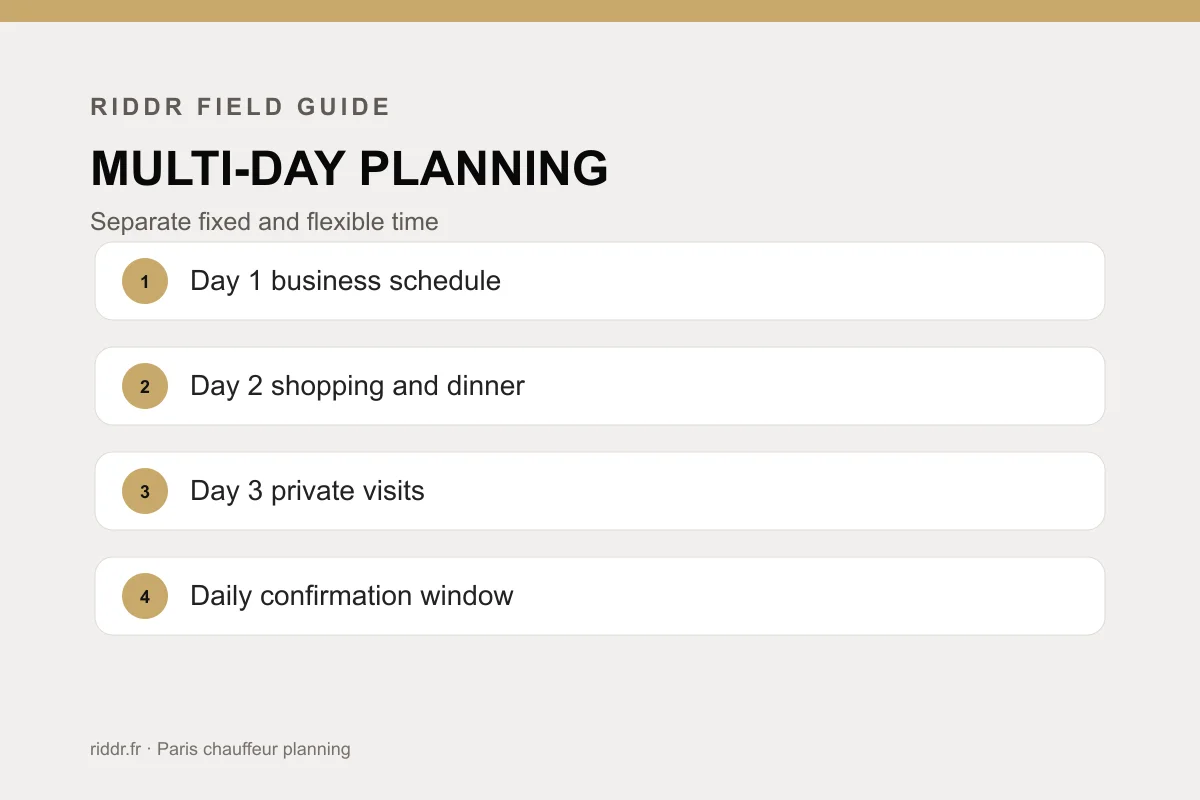
- Create one page per day
- State the purpose of each day
- Identify the earliest and latest likely times
Balance continuity and safe staffing
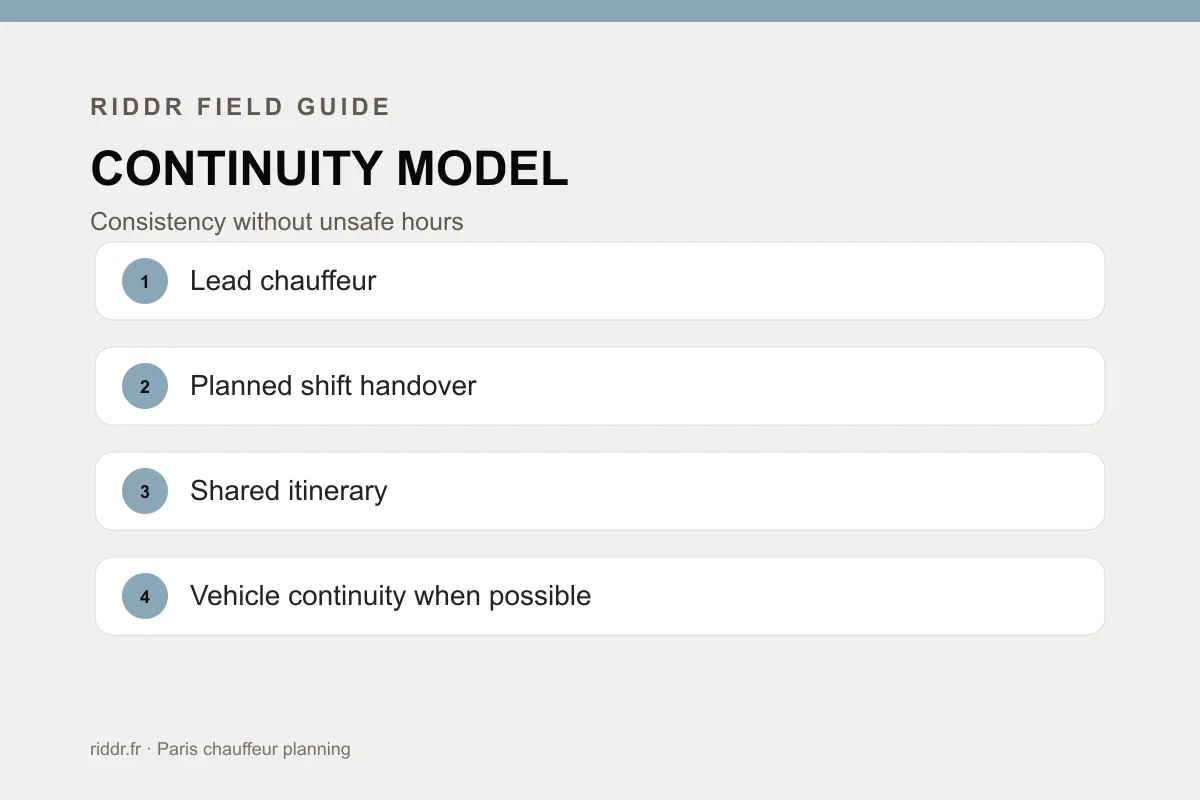
Guests often value seeing the same chauffeur and vehicle throughout a stay. Continuity builds familiarity with preferences and routes. It cannot override safe working practices. If the schedule combines early mornings and late nights, use a lead chauffeur with planned handovers. The guest still receives one coordinated service even when the operating team changes responsibly.
The practical task is to convert that insight into instructions that can be checked. Before confirming the service, decide who needs each detail, when it must be updated and which change would affect price, timing or vehicle capacity. A useful itinerary does not pretend to predict every minute. It makes priorities, assumptions and operating limits visible.
- Request continuity as a preference
- Identify days needing shift coverage
- Document every handover
Build daily operating windows
An operating window is more useful than a list of approximate attractions. It defines when the vehicle must be available and which appointments anchor the day. Optional stops can then move inside that window. For a five-day stay, this also prevents a quiet morning from being priced and staffed like a fourteen-hour event day.
The practical task is to convert that insight into instructions that can be checked. Before confirming the service, decide who needs each detail, when it must be updated and which change would affect price, timing or vehicle capacity. A useful itinerary does not pretend to predict every minute. It makes priorities, assumptions and operating limits visible.
- Set a start and finish range
- Mark fixed reservations
- Keep one optional block
Review tomorrow every evening
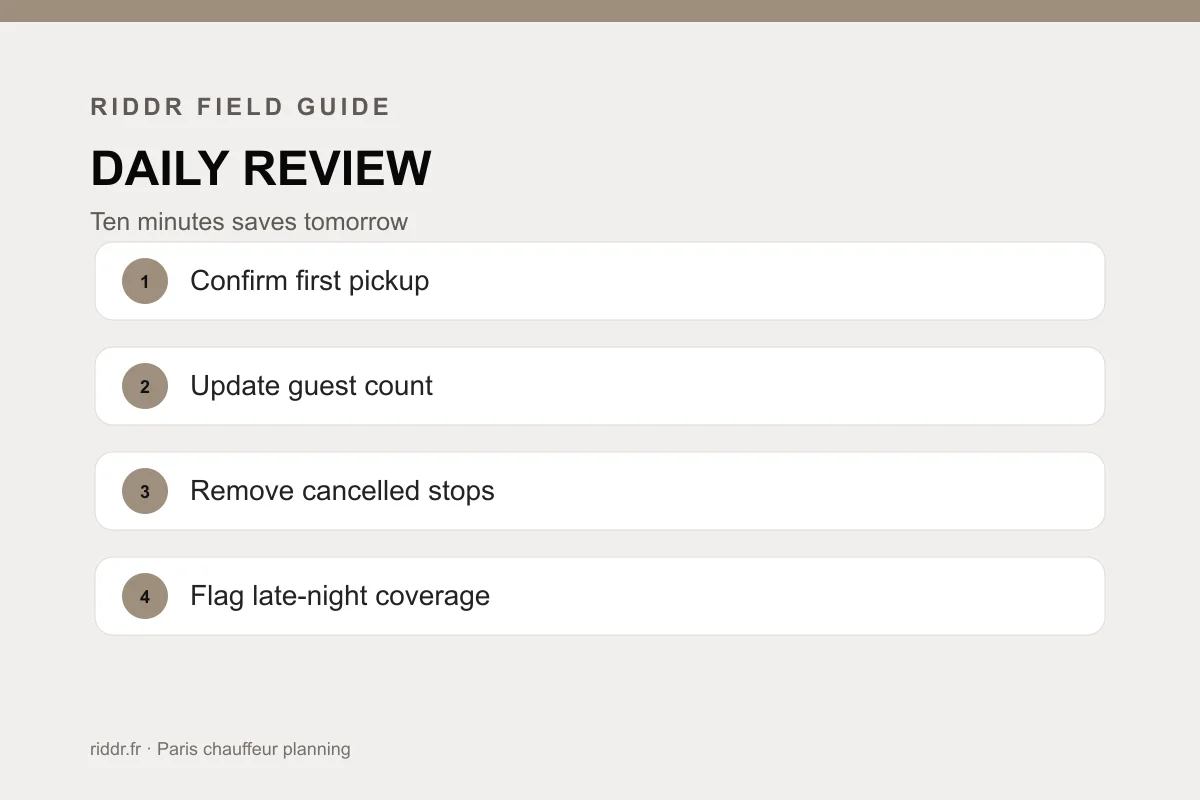
A ten-minute review after the final stop catches changed guest counts, cancelled meetings and new restaurant plans. It also confirms the next pickup, which is the detail most likely to create morning confusion. The review should update the master plan rather than start a separate conversation with the next driver.
The practical task is to convert that insight into instructions that can be checked. Before confirming the service, decide who needs each detail, when it must be updated and which change would affect price, timing or vehicle capacity. A useful itinerary does not pretend to predict every minute. It makes priorities, assumptions and operating limits visible.
- Confirm first pickup
- Recheck passenger count
- Publish one revised itinerary
Choose a vehicle for the stay
The right vehicle depends on the most demanding recurring use, not the largest single transfer. A sedan may be ideal for an executive couple. A V-Class supports a family, assistants or shopping days more comfortably. If one day requires exceptional capacity, adding a second vehicle for that day can be more efficient than oversizing the entire stay.
The practical task is to convert that insight into instructions that can be checked. Before confirming the service, decide who needs each detail, when it must be updated and which change would affect price, timing or vehicle capacity. A useful itinerary does not pretend to predict every minute. It makes priorities, assumptions and operating limits visible.
- Identify the regular passenger group
- List exceptional days
- Consider calls and working space
Prepare a quote that can be audited
A multi-day quote should show dates, hours, vehicle, included service area and conditions for extra time. It should also make assumptions visible where the itinerary is incomplete. That lets the client compare offers on equivalent scope instead of choosing a low headline price that excludes the hours actually needed.
The practical task is to convert that insight into instructions that can be checked. Before confirming the service, decide who needs each detail, when it must be updated and which change would affect price, timing or vehicle capacity. A useful itinerary does not pretend to predict every minute. It makes priorities, assumptions and operating limits visible.
- Compare included hours
- Check night and distance conditions
- Ask how changes are approved
A worked schedule example
- Day 1: business meetings
- Day 2: private visits and shopping
- Day 3: event schedule
- Day 4: flexible family programme
- Day 5: final meetings and dinner
This example is not a universal duration claim. It shows how a useful brief combines commitments, margin and a defined finishing point. Dispatch can quote and plan more accurately when it knows which parts are mandatory and which may move if the day changes.
Mistakes that create avoidable friction
- Requesting 24/7 coverage without shift planning
- Using one vague itinerary for every day
- Choosing a vehicle from the easiest day
- Failing to reconfirm the next morning
These errors look minor on a spreadsheet, yet they usually surface after the vehicle is already in service. Fixing them in advance reduces messages, waiting and disagreement between what the client imagined and what the provider priced. The strongest chauffeur plan is often the one with the fewest unresolved assumptions.
How to request an auditable quote
Send the date, Paris local start time, expected duration, passenger count, preferred vehicle and main stops. Add language, materials, child seats or access requirements. Ask the proposal to state included hours, extension conditions and exceptional expenses. For a schedule-based proposal, review Riddr's private chauffeur by the day in Paris and Paris sightseeing chauffeur planning. For a different service format, the request a multi-day quote provides the next relevant step.
Frequently asked questions
Will I have the same chauffeur every day?
Continuity can be requested and is often possible, but extended hours may require planned driver changes.
Can each day have different hours?
Yes. Each date should be quoted from its own operating window and requirements.
Can the schedule be changed during the stay?
Yes, provided updates are coordinated and any change in hours, distance or vehicles is confirmed.
Related guides and services
Final recommendation
The quality of a chauffeur service is largely decided before the vehicle door opens. A prioritized itinerary, one authorized contact and a written scope turn flexibility into a controlled operation. Riddr's position is simple: describe the real day, including uncertainty, rather than requesting a generic rate and hoping every later requirement is included.