Guides
Paris Fashion Week Chauffeur: Logistics Beyond the Car
Plan the transport layer behind Fashion Week: venue access, vehicle roles, changing schedules and one controlled communication channel.

A Paris Fashion Week chauffeur service is a logistics operation, not merely a luxury arrival. The car must be assigned to the right guest or team, the driver needs workable pickup points, and one coordinator must translate moving show, fitting and dinner times into clear instructions. Good transport protects the schedule when venues and access conditions change.
This guide explains how to plan Paris Fashion Week chauffeur logistics with clear timings, responsibilities and operating limits.
Key takeaways
- Plan venue access, not just addresses
- Assign each vehicle a role
- Keep one live schedule
- Staff late coverage explicitly
What a Paris Fashion Week chauffeur really manages
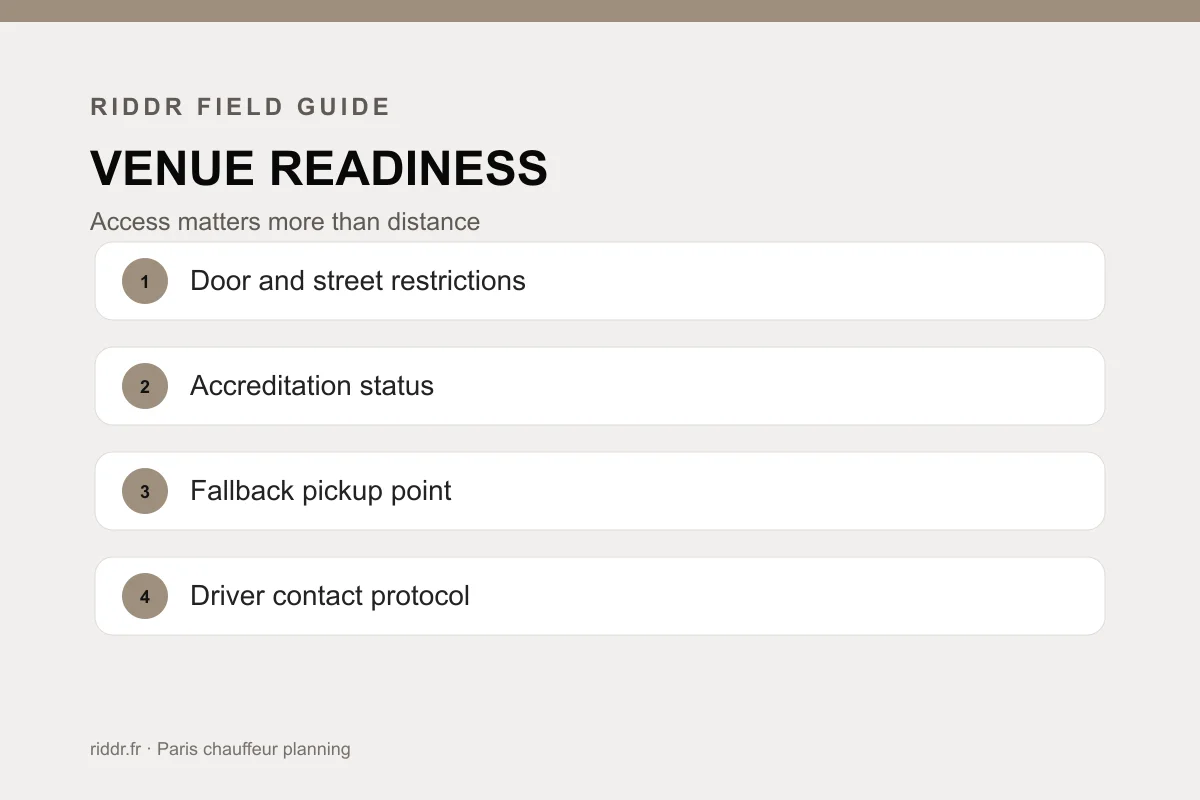
Fashion Week days connect fittings, showrooms, presentations, private appointments, shows and dinners. Their value lies in the transitions. A chauffeur who only receives the next address cannot anticipate a restricted street, a distant holding point or a venue where guests exit from another door. The operational brief should explain the purpose and access window of every stop.
The practical task is to convert that insight into instructions that can be checked. Before confirming the service, decide who needs each detail, when it must be updated and which change would affect price, timing or vehicle capacity. A useful itinerary does not pretend to predict every minute. It makes priorities, assumptions and operating limits visible.
- Name the venue and event
- Record access instructions
- Identify a fallback pickup point
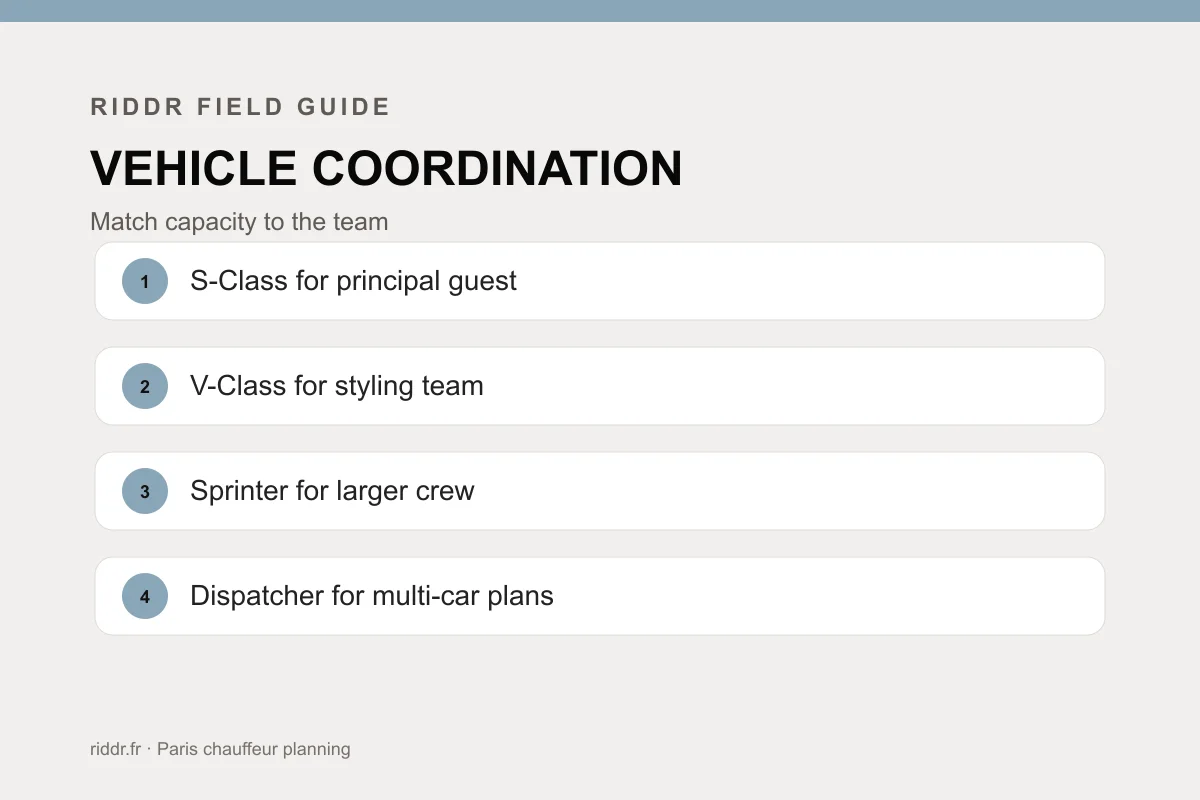
Match vehicles to the team
An S-Class may suit a principal guest, while a V-Class often works better for a styling team, assistants or garment bags. A Sprinter can support larger groups, but it needs different curb access and loading time. Coordinating several vehicles requires labels and passenger assignments so that the right people, passes and materials arrive together.
The practical task is to convert that insight into instructions that can be checked. Before confirming the service, decide who needs each detail, when it must be updated and which change would affect price, timing or vehicle capacity. A useful itinerary does not pretend to predict every minute. It makes priorities, assumptions and operating limits visible.
- Assign a principal vehicle
- Keep team capacity together
- Avoid last-minute vehicle swaps
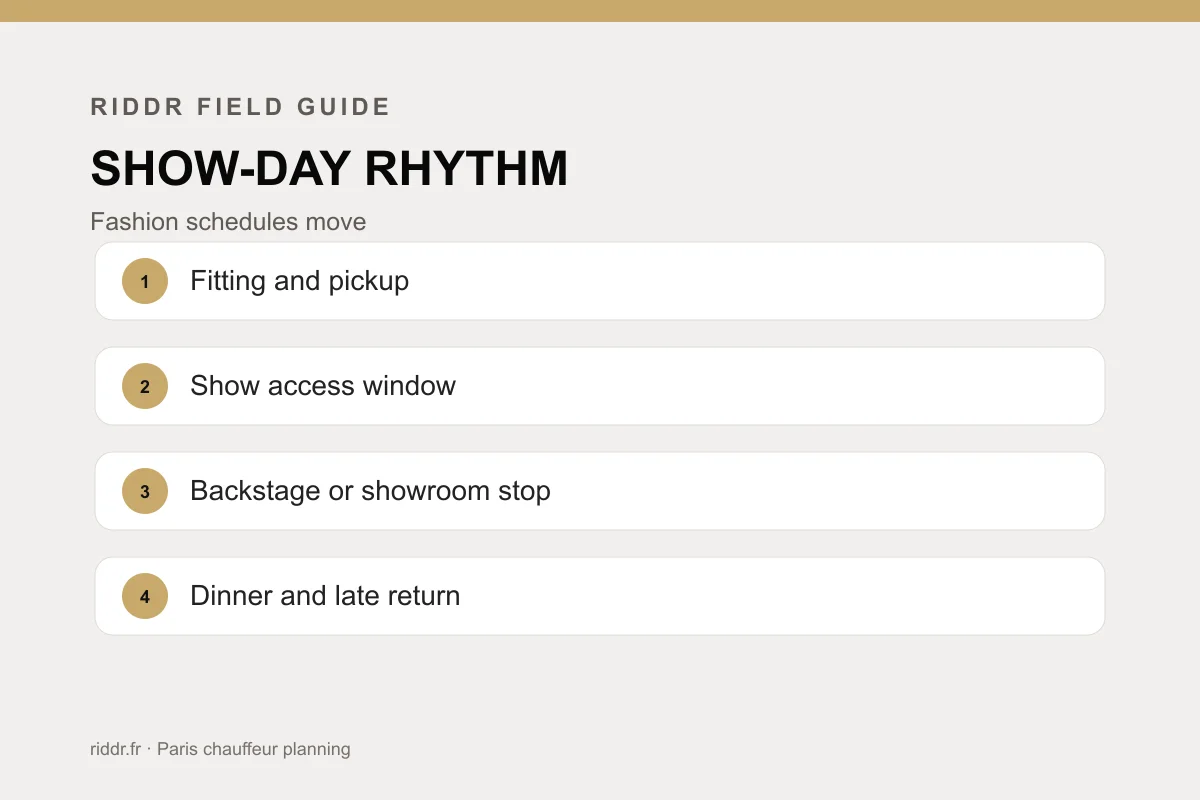
Design for show delays
Shows rarely operate like fixed business appointments. Entry, seating and exit can all move. The plan should protect the next non-negotiable commitment and show which stops may be dropped. A driver waiting at an unusable door is not providing flexibility. Dispatch should be able to move the pickup point while the guest receives one concise update.
The practical task is to convert that insight into instructions that can be checked. Before confirming the service, decide who needs each detail, when it must be updated and which change would affect price, timing or vehicle capacity. A useful itinerary does not pretend to predict every minute. It makes priorities, assumptions and operating limits visible.
- Rank the next commitments
- Pre-approve alternative pickup streets
- Share changes through one contact
Handle fittings and garments
Garment bags, samples and styling cases affect vehicle choice and loading. They should not be treated as ordinary luggage added at the last minute. The team needs enough capacity without placing valuable items visibly in an unattended vehicle. If collections move separately from the guest, that movement should have its own responsible contact and inventory logic.
The practical task is to convert that insight into instructions that can be checked. Before confirming the service, decide who needs each detail, when it must be updated and which change would affect price, timing or vehicle capacity. A useful itinerary does not pretend to predict every minute. It makes priorities, assumptions and operating limits visible.
- Declare garment volume
- Choose enclosed capacity
- Assign responsibility for materials
Coordinate dinners and late returns
Evening events often extend beyond the daytime booking. Decide whether the same vehicle waits, returns at a confirmed time or is replaced by a planned night shift. The language should be precise: round-the-clock service means coordinated coverage, not one chauffeur working indefinitely. This protects safety and avoids a late commercial dispute.
The practical task is to convert that insight into instructions that can be checked. Before confirming the service, decide who needs each detail, when it must be updated and which change would affect price, timing or vehicle capacity. A useful itinerary does not pretend to predict every minute. It makes priorities, assumptions and operating limits visible.
- Set the daytime finish
- Quote late coverage
- Confirm the final passenger group
Use a single communication protocol
A fashion team may include a client, assistant, stylist, agency and security contact. Only one or two people should be authorized to change transport. Messages should include the vehicle, new time, exact pickup and affected passengers. Voice notes without context are easy to misunderstand in a noisy venue; short structured messages are faster in practice.
The practical task is to convert that insight into instructions that can be checked. Before confirming the service, decide who needs each detail, when it must be updated and which change would affect price, timing or vehicle capacity. A useful itinerary does not pretend to predict every minute. It makes priorities, assumptions and operating limits visible.
- Name the transport coordinator
- Use structured updates
- Require driver or dispatch acknowledgement
A worked schedule example
- 09:00 fitting
- 11:30 showroom appointment
- 14:00 show access
- 17:30 presentation
- 20:30 dinner
- 23:00 planned return coverage
This example is not a universal duration claim. It shows how a useful brief combines commitments, margin and a defined finishing point. Dispatch can quote and plan more accurately when it knows which parts are mandatory and which may move if the day changes.
Mistakes that create avoidable friction
- Treating every venue door as accessible
- Sending the same vehicle for guests and large garment loads
- No alternative pickup point
- Assuming the day package automatically covers late events
These errors look minor on a spreadsheet, yet they usually surface after the vehicle is already in service. Fixing them in advance reduces messages, waiting and disagreement between what the client imagined and what the provider priced. The strongest chauffeur plan is often the one with the fewest unresolved assumptions.
How to request an auditable quote
Send the date, Paris local start time, expected duration, passenger count, preferred vehicle and main stops. Add language, materials, child seats or access requirements. Ask the proposal to state included hours, extension conditions and exceptional expenses. For a schedule-based proposal, review Riddr's Fashion Week chauffeur service and multi-vehicle chauffeur options. For a different service format, the send a Fashion Week schedule provides the next relevant step.
Frequently asked questions
Can one chauffeur cover every Fashion Week event?
One chauffeur can cover a defined schedule, but long or overlapping days may require additional vehicles or planned driver shifts.
Which vehicle is best for a fashion team?
A V-Class is often practical for assistants and materials, while a sedan may be reserved for a principal guest.
Can pickup points change?
Yes. Alternative pickup points should be planned because venue restrictions and crowd control can make the original door unusable.
Related guides and services
Official planning references
Check official opening times and calendars before finalizing the itinerary:
Final recommendation
The quality of a chauffeur service is largely decided before the vehicle door opens. A prioritized itinerary, one authorized contact and a written scope turn flexibility into a controlled operation. Riddr's position is simple: describe the real day, including uncertainty, rather than requesting a generic rate and hoping every later requirement is included.