Guides
Paris Sightseeing with a Private Driver: Build a Realistic Day
Design a private sightseeing day that respects Paris geography, timed entries, walking time and the difference between a driver and a guide.

Paris sightseeing with a private driver works best when the day covers two or three geographic zones, not a checklist of every landmark. The driver manages mobility and agreed pickup points; a licensed guide is a separate role when in-depth commentary or guided entry is required. Timed tickets, walking time, meals and family comfort should anchor the plan.
This guide explains how to plan Paris sightseeing with a private driver with clear timings, responsibilities and operating limits.
Key takeaways
- Choose two or three zones
- Separate driver and guide roles
- Book timed entries first
- Plan walking and recovery time
What a Paris sightseeing private driver provides
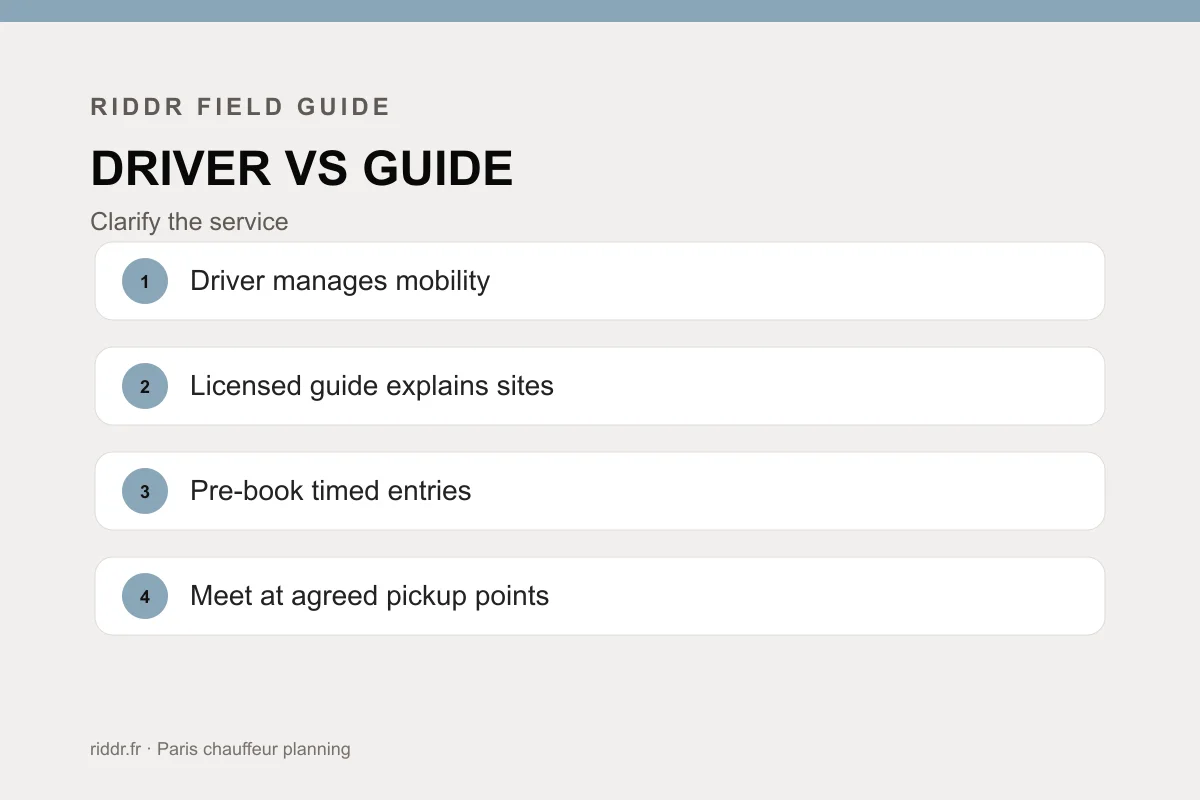
A private driver manages the transport layer: pickup, route, waiting and repositioning. The service can connect monuments, neighbourhoods, lunch and private appointments without forcing the group to arrange a new car after every visit. It should not be described as licensed guiding unless a qualified guide is also included in the booking.
The practical task is to convert that insight into instructions that can be checked. Before confirming the service, decide who needs each detail, when it must be updated and which change would affect price, timing or vehicle capacity. A useful itinerary does not pretend to predict every minute. It makes priorities, assumptions and operating limits visible.
- Clarify driver-only or driver-plus-guide
- Share timed entries
- Agree pickup points after pedestrian visits
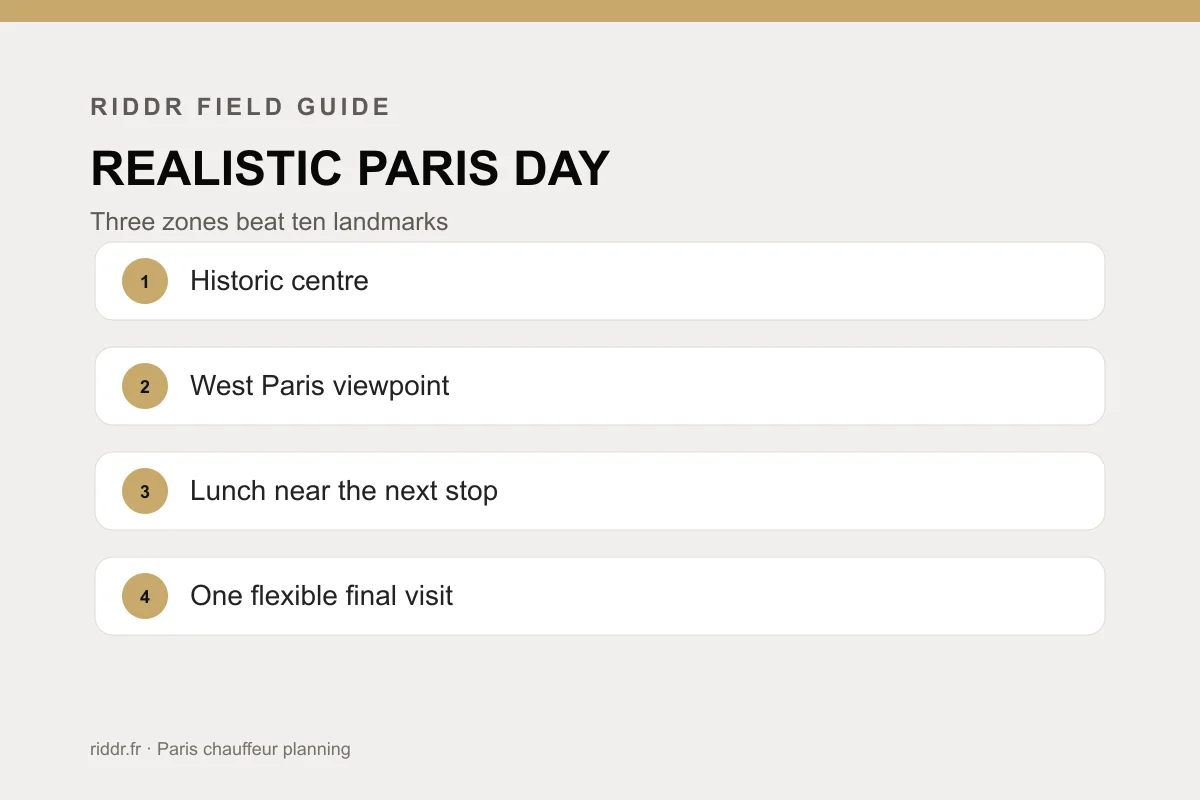
Build the day by geographic zones
The historic centre, western landmarks, Montmartre and the Left Bank each require time outside the vehicle. A realistic plan groups nearby places. Three meaningful stops with room to walk often produce a better day than eight rushed photo stops. The vehicle saves friction between zones; it does not remove queues, security checks or the distance inside major sites.
The practical task is to convert that insight into instructions that can be checked. Before confirming the service, decide who needs each detail, when it must be updated and which change would affect price, timing or vehicle capacity. A useful itinerary does not pretend to predict every minute. It makes priorities, assumptions and operating limits visible.
- Select one morning zone
- Place lunch near the afternoon area
- Keep one optional final stop
Start with timed tickets
Museum and monument entry times are the hard edges of a sightseeing itinerary. Build transport backward from those times and add an arrival margin. A driver cannot compensate for a guest leaving lunch after the ticket window. Share the booking confirmation time, visitor entrance and any group requirements with the coordinator.
The practical task is to convert that insight into instructions that can be checked. Before confirming the service, decide who needs each detail, when it must be updated and which change would affect price, timing or vehicle capacity. A useful itinerary does not pretend to predict every minute. It makes priorities, assumptions and operating limits visible.
- List ticket times
- Confirm the correct entrance
- Allow security and walking time
Plan for children and older guests
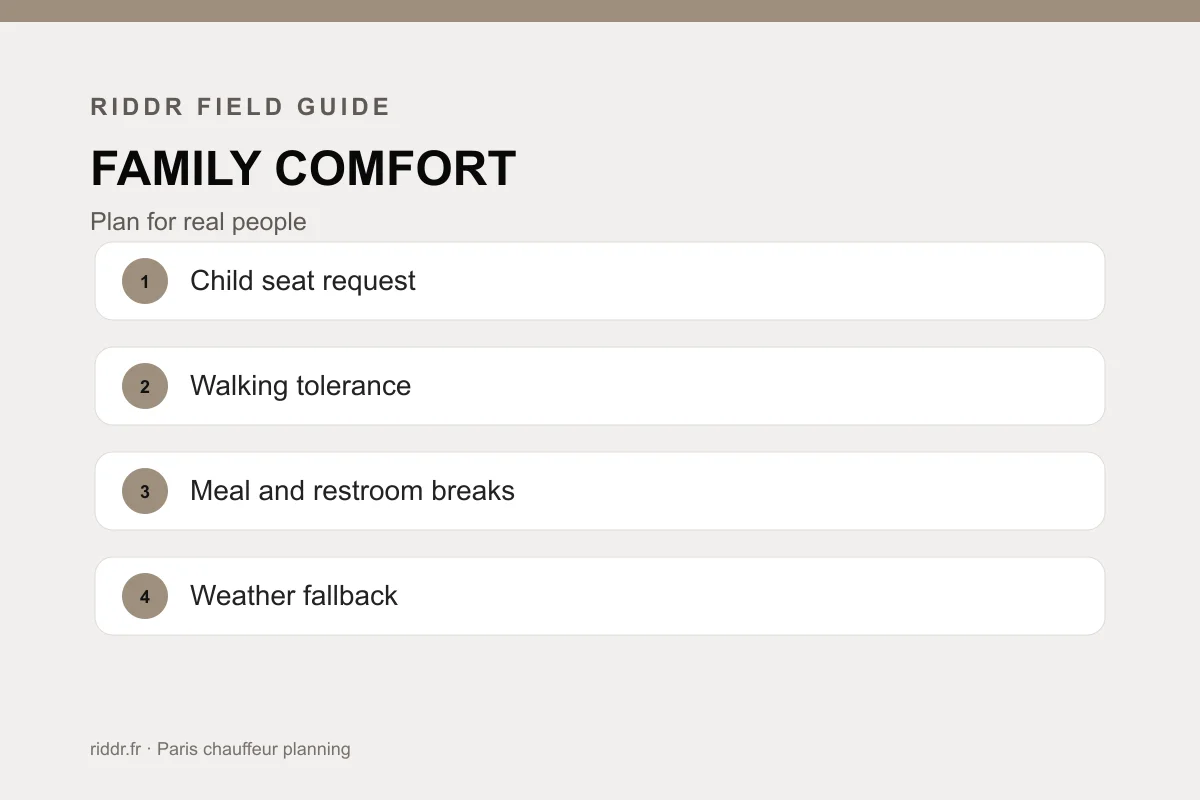
Walking tolerance, child seats, meal timing and restroom breaks affect the route more than a generic list of highlights. Tell the service provider about mobility needs before vehicle assignment. The best itinerary includes recovery periods and weather alternatives, particularly in heat, rain or a crowded holiday period.
The practical task is to convert that insight into instructions that can be checked. Before confirming the service, decide who needs each detail, when it must be updated and which change would affect price, timing or vehicle capacity. A useful itinerary does not pretend to predict every minute. It makes priorities, assumptions and operating limits visible.
- Request child seats early
- State mobility constraints
- Add a weather fallback
Use legal pickup points
Many landmark entrances are pedestrianized or restricted. The agreed pickup point may be on a nearby street rather than at the monument door. Guests should receive a simple location link and vehicle description. Repeated calls asking a chauffeur to stop illegally create delay and can make the pickup less safe.
The practical task is to convert that insight into instructions that can be checked. Before confirming the service, decide who needs each detail, when it must be updated and which change would affect price, timing or vehicle capacity. A useful itinerary does not pretend to predict every minute. It makes priorities, assumptions and operating limits visible.
- Confirm the pickup street
- Share a map pin
- Walk to the vehicle only after acknowledgement
Protect flexibility without losing the day
Keep one optional stop and decide what can be removed if a visit runs long. That makes the day flexible without turning every decision into a debate. The chauffeur should know the priorities, while the family retains control of how long to stay. Flexibility is a ranking system, not the absence of a plan.
The practical task is to convert that insight into instructions that can be checked. Before confirming the service, decide who needs each detail, when it must be updated and which change would affect price, timing or vehicle capacity. A useful itinerary does not pretend to predict every minute. It makes priorities, assumptions and operating limits visible.
- Rank must-see and optional sites
- Set a latest departure
- Protect the final reservation
A worked schedule example
- 09:00 historic centre walk
- 11:30 timed museum entry
- 14:00 lunch
- 15:30 western Paris viewpoint
- 17:30 optional final neighbourhood
This example is not a universal duration claim. It shows how a useful brief combines commitments, margin and a defined finishing point. Dispatch can quote and plan more accurately when it knows which parts are mandatory and which may move if the day changes.
Mistakes that create avoidable friction
- Confusing a driver with a licensed guide
- Booking too many timed entries
- Ignoring walking time
- Expecting pickup at restricted monument doors
These errors look minor on a spreadsheet, yet they usually surface after the vehicle is already in service. Fixing them in advance reduces messages, waiting and disagreement between what the client imagined and what the provider priced. The strongest chauffeur plan is often the one with the fewest unresolved assumptions.
How to request an auditable quote
Send the date, Paris local start time, expected duration, passenger count, preferred vehicle and main stops. Add language, materials, child seats or access requirements. Ask the proposal to state included hours, extension conditions and exceptional expenses. For a schedule-based proposal, review Riddr's Paris sightseeing chauffeur service and private driver in Paris. For a different service format, the request a sightseeing quote provides the next relevant step.
Frequently asked questions
Does the chauffeur guide inside monuments?
Not unless a licensed guide is explicitly included. The chauffeur normally manages transport and waiting.
How many landmarks fit in one day?
Two or three geographic zones with a few priority sites are usually more realistic than trying to cover the entire city.
Can a child seat be provided?
Request the correct seat type and child details when asking for the quote so the vehicle can be prepared.
Related guides and services
Official planning references
Check official opening times and calendars before finalizing the itinerary:
Final recommendation
The quality of a chauffeur service is largely decided before the vehicle door opens. A prioritized itinerary, one authorized contact and a written scope turn flexibility into a controlled operation. Riddr's position is simple: describe the real day, including uncertainty, rather than requesting a generic rate and hoping every later requirement is included.